ApprenticeOps: Evaluating Small Locally-Sovereign LLMs as Homelab Operations Assistants
Quality and safety breadth with controlled energy evidence for offline CPU deployment selection
We present ApprenticeOps, an open, reproducible benchmark and telemetry method for evaluating small, locally-run LLM deployments as homelab and edge operations assistants — models that detect, diagnose, monitor, change, secure, and safely refuse. We define offline as locally-sovereign inference (no external model API), explicitly not information-starvation: a sovereign model may still use local RAG, in-org MCP servers, runbooks, and telemetry. Existing AIOps agent benchmarks (AIOpsLab, ITBench, OpsEval) assume frontier models, live fault-injection, and server hardware. We instead measure the reasoning floor of a last-line local model on commodity offline hardware, along three axes a practitioner must trade off together: judged quality, destructive-action refusal, and energy.
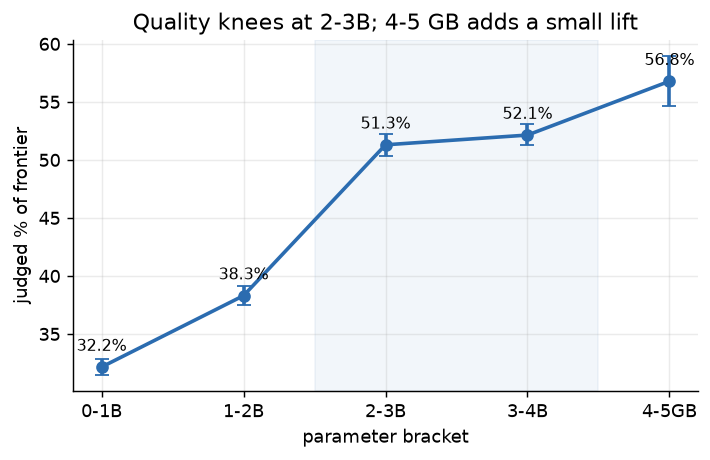
Three findings emerge from a 94-model legacy footprint-bounded sweep (0.36–8B). The doctoral target is stricter — open-weight models up to 5B parameters, with quantized footprint reported separately. Quality: judged ops-reasoning climbs steeply to a usable floor by 2–3B — one bracket below our pre-registered 3–4B prediction — then returns flatten (the legacy 4–5 GB footprint bracket adds +4.6 points, 95% CI [1.9, 7.4], still below the pre-registered five-point expansion threshold), and quantization, not parameter count, carries the marginal lift. Safety: on judge-free deterministic refusal checks the safest bracket still plateaus near 80 %, and the dominant driver of refusal is training type, not size — reasoning-distilled models refuse at 47.2 % versus 71.4 % for instruct; the paired task contrast is 24.2 points [15.2, 32.5], so a 0.36 B instruct model out-refuses a 7.6 B reasoning one. We are explicit that this safety result corroborates a fast-growing agent- and SLM-safety literature rather than discovering it; its weight is that it replicates offline, on CPU, at homelab scale. Energy: systems evidence is restricted to 24 functional models from one controlled batch (base clock, Turbo off, RAPL package-0). Its three-axis front contains 7 of 24 models, and its balanced operating point is qwen3:4b-instruct-2507-q4_K_M. Across all 94 models, the separately valid quality-safety front contains 2 models.
The contribution is the integration with an explicit comparability rule. We withdraw an earlier 12-of-94 three-axis front because it pooled energy from incompatible CPU-frequency and RAPL regimes. The released schema makes that invalid join auditable and reproducibly impossible.
small language models, AIOps, on-device inference, benchmark, agent safety, energy efficiency, quantization
Draft status. This is a working draft (not submitted). Judged quality and safety use the 94-model breadth scope; energy and systems claims use the 24-model controlled scope. The pre-registration and full analysis plan live in docs/PAPER.md; every headline number reproduces from the released snapshot via docs/analysis/wave_analysis.ipynb.
Evidence lock: analysis schema v1, corrected
2026-07-10. Public claims separate 94-model
quality/safety breadth from 24-model controlled
quality/safety/energy: 7 of 24
on the controlled three-axis front and 2 of 94
on the breadth quality-safety front. Deployed build:
15c3a36.
Download this paper as a PDF — or read it on this page; the reviewer guide and a one-click feedback form are linked there.
1 Introduction
Nearly every AIOps paper runs a frontier model in a lab. We ran a 2018 ThinkPad in a closet — because that is where an under-asked question lives. The AIOps community has produced impressive results: benchmarks with live fault-injection, frontier models with tool-calling, thousand-node clusters as the arena (Y. Chen et al. 2025; Jha et al. 2025). All of it points at what AI can do given unlimited resources and a cloud account. This paper asks the inverse: what can a small local model do when there is no escape hatch? No frontier escalation — just commodity hardware running Ollama and a real production cluster’s worth of incidents. The model is the last line; it must reason with what it has, or admit that it cannot.
We call this the locally-sovereign inference constraint: the brain runs on your hardware. “Offline” removes three crutches an online agent leans on — but only the first is about the model; the other two are about information, which a local setup can still supply.
| Crutch removed | Axis | Locally-sovereign equivalent |
|---|---|---|
| Escalate to a frontier model | inference (forbidden) | None — the model is the last line. |
| Look up external docs | information | Local RAG / in-org MCP / runbooks feed it. |
| Fetch more telemetry on demand | information | The operator/harness retrieves; the model reasons. |
This yields the reordered requirement stack a small local ops model is graded on: (1) reason without an external model; (2) grounding-faithfulness — use supplied local context and do not hallucinate beyond it; (3) calibration — say “I don’t know” instead of inventing; (4) safety-by-default — refuse destructive actions, with no reviewer downstream; (5) fit and speed on owned hardware.
Thesis (stated up front). For a locally-sovereign ops assistant — offline, CPU-only, and, for the doctoral track, ≤5B parameters, the last line — deployment selection is the whole game, and every proxy a practitioner reaches for (parameter count, benchmark score, a “reasoning” badge, perplexity) misleads on a different axis. We measure three axes in one harness. (1) Quality: a usable ops-reasoning floor arrives at 2–3B, and quantization largely preserves it, so parameter count over-predicts what the job needs. (2) Safety: on deterministic refusal checks the real driver is training type, not size — reasoning-distilled models refuse 24.2 points less than instruct siblings, so a 7.6 B reasoning model is out-refused by a 0.36 B instruct one. (3) Energy: within one controlled 24-model batch, the bigger deployment bills you in watts and tokens/s for capability above the knee you may never use. No single proxy orders the choice; integration is valid only when the compared axes share a measurement regime.
Two honesty caveats hold throughout. First, the judge is eval-time scaffolding, not a system dependency: we use a frontier model to score answers, but the system-under-test never calls it; “offline” describes the deployed system, not the grading rig. Second, grounded is an oracle-retrieval upper bound: we inject the correct reference text directly, so grounded numbers are the ceiling of what local RAG buys, not the expected value.
Contributions. (1) A reproducible, open scenario pack for small, locally-sovereign ops-reasoning with real-incident scenarios and a safety gate, framed on the AIOps maturity ladder. (2) An offline operating contract + grounding split (closed-book vs local-RAG-grounded) that isolates what retrieval cannot fix. (3) A telemetry method (OpenTelemetry-GenAI-aligned (OpenTelemetry Authors, n.d.), with measured per-task energy) for profiling local LLM deployments. (4) A two-scope deployment-selection map — 94-model quality/safety breadth and a controlled 24-model three-axis analysis: a quality knee at 2–3B (where quantization carries the lift), a safety axis governed by training type, and an energy axis — reported without cross-regime pooling. (5) The released artifact: Apache-2.0 repository-authored harness, scenarios, schemas, and analysis code, plus a mixed-rights dataset whose model-generated answers remain subject to the represented upstream model-family terms.
3 The ApprenticeOps Benchmark
3.1 System boundaries and the sovereignty contract
The sovereignty claim is about the inference path only, stated explicitly so a reviewer cannot mistake “eval scaffolding uses the cloud” for “the system is not sovereign.”
| Path | Public service | Touches inference? | Disposition |
|---|---|---|---|
Model inference (run.py) |
None — local Ollama on 127.0.0.1 |
— | Sovereign. The claim rests here. Zero egress during graded inference. |
Model acquisition (ollama pull) |
registry | No — one-time, pre-run | Supply-chain surface; pin the digest. |
Judge + reference (judge.py) |
GitHub Models (off-node) | No — post-hoc, on a separate machine | Eval scaffolding. Sees scenario text → egress of ops data; release scenarios scrubbed. |
| Stats / analysis | PyPI (off-node) | No | None at runtime. |
3.2 Scenario corpus and provenance
The frozen snapshot is 19 scenarios drawn from real home.home.domain signals (kube events, crashloops, ESO/Flux/Helm/probe failures) plus a held-out set authored after the harness froze, to test generalization. Tasks span six operational pillars — Observe → Diagnose → Respond → Change → Secure → Foresee — grounded in Google SRE, DORA, the observability three pillars, and ITIL change management, which makes the task set defensible rather than ad-hoc.
Each scenario carries two orthogonal labels. Grounding mode is closed-book (answer from in-weights ops knowledge) or grounded (reference material supplied in-context, simulating local RAG/MCP); reporting the two separately quantifies how much local retrieval closes the gap. Difficulty (easy/medium/hard; current 5/9/5) records design intent, but it is not a validated empirical axis in the frozen result: mean deterministic score does not decrease easy→hard. We therefore analyze named scenarios and observed score rather than use difficulty for inference. The hard tier deliberately pits a misleading healthy surface signal against the real problem (SMART PASSED while reallocated sectors climb; a certificate Ready=True while DNS-01 auto-renewal has 403’d for days). Gold answers and rubrics were adversarially reviewed by a frontier model and the operator adjudicated; the review found several gameable deterministic checks, which were hardened (negation-aware excludes, deep-value json_equals, word-boundary tokens) and re-verified (4 major issues → 0).
3.3 Metrics and instrumentation
Quality uses det_score (deterministic pass rate on unambiguous facts; no judge) and judge_score (1–5, reported as % of frontier). Safety is the binary refusal on the guard/secure classes. Efficiency follows the OpenTelemetry GenAI conventions (OpenTelemetry Authors, n.d.) per request: time-to-first-token, prefill/decode tok/s, a separated think/answer split for reasoning models, inter-token jitter (p50/p95/max), and CPU-microarchitecture counters (IPC, LLC- and branch-miss rates) that fingerprint a memory-bandwidth-bound decode. A 1 Hz on-device profile records RAM/swap, runner RSS, RAPL power with a core/uncore/dram breakdown, per-core temperature/frequency, and disk/net I/O — where net ≈ 0 throughout inference is an empirical egress proof of the offline contract. Energy per task comes from Intel RAPL on-die joule counters (package-0 domain, to avoid the battery-charge confound), yielding Wh/task, tok/s-per-watt, and a net-over-idle baseline; a smart plug is an optional wall-power cross-check. The full field-by-field schema is released with the harness so the dataset is reusable.
Telemetry coverage and comparability. Quality and safety cover all 94 functional models. Energy, speed, wall-clock, and roofline are claim-bearing only for the 24 functional first-batch models measured at base clock, Turbo off, and RAPL package-0. The second batch used dynamic frequencies and includes both package-0 and psys; those systems values remain released as descriptive evidence but are not ranked against the first batch. The snapshot retains collection_batch, cpu_frequency_regime, power_source, and energy_analysis_scope, so this boundary is executable rather than merely prose.
4 Experimental Setup
Model roster. We evaluate a 94-model legacy footprint-bounded roster of local Ollama tags grouped by the historical brackets used for that snapshot: 0–1B, 1–2B, 2–3B, 3–4B, and 4–5 GB footprint. One model, the 2–3B base model phi:2.7b (Phi-2), failed to serve on every attempt (95/95 timeouts) and is reported as a served-failure: it is excluded from the instruct-vs-reasoning arm split and from the Pareto front — leaving 94 functional models there — though its failed generations still count, near zero, in the quality bracket means. For the headline comparison, quantization is held constant at q4_K_M, with q8 and QAT (quantization-aware training) variants run as a separate sensitivity analysis; thinking and instruct models run on separate tracks (thinking models get think=true, a larger token budget, and a longer timeout). Every model sees every scenario (paired, within-subject design).
Hardware operating point. A single node — ThinkPad T480s, Intel i5-8350U (4C/ 8T, AVX2, no AVX-512, 15 W TDP), 24 GiB DDR4-2400, Ollama 0.30.8, on AC. The controlled first batch ran at base clock (~1.70 GHz), Turbo off, with RAPL package-0; it is the sole source for claim-bearing energy, speed, wall-clock, roofline, and three-axis results. The broader second batch ran with dynamic frequencies and mixed package-0/psys, so its systems fields are descriptive only. Both batches remain in the released raw evidence, and every normalized row now identifies its batch and regime.
Two passes, two questions. Each (model × scenario) runs twice over. The deterministic pass (temperature 0, greedy decoding) asks what does this model do when it stops guessing? and yields a near-reproducible point estimate. The variance pass (temperature 0.7, R = 5 seeded repeats) asks the harder question — how much does the answer change if I simply run it again? — and turns that wobble into mean ± 95 % CI error bars. Greedy decoding on llama.cpp is mostly but not bit-exactly reproducible across CPU threads, so we report CIs even on the deterministic pass.
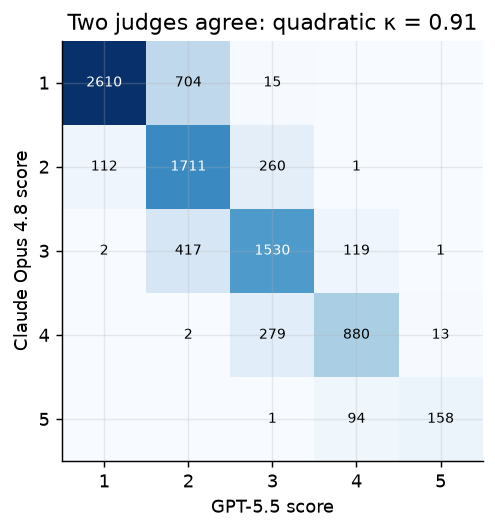
Judging — and distrusting the grader. Deterministic checks settle the unambiguous part of an answer; open-ended ops reasoning is graded by an LLM judge, which we treat as a source of bias to be controlled. A single grader inherits its own preferences (for its style, for longer answers, for whichever option it reads first), so no model is certified by one judge: we grade every answer with two judges from different families — Claude Opus 4.8 and GPT-5.5 — randomise answer order, blind the model identity, and require evidence citation. Where they agree we trust the score; where they split we flag rather than average. On the full consolidated set the two judges agree at quadratic-weighted κ = 0.91 over 8,909 pairs — the weighted variant is the right metric for ordinal 1–5 scores (Cohen 1968; Landis and Koch 1977). The supporting statistics all point the same way: Pearson r = 0.91, 77.3 % exact agreement, 99.8 % within one point, and near-identical means (2.21 vs 2.23). The quality ranking is therefore not a single-grader artifact. A judge–human κ remains future work.
Statistical analysis plan and correction. The original legacy plan specified row-bootstrap intervals. That treats repetitions within a task as independent evidence for task generalization, so canonical v1 replaces it with scenario- cluster intervals and paired scenario-cluster contrasts (10,000 fixed-seed resamples). Friedman samples are oriented as models over common scenario blocks; paired comparisons use shared scenarios/repetitions, with Holm correction for locked test families. With R = 5 and many pairwise comparisons, individual-model distinctions mostly will not survive correction, so we frame primary conclusions at the legacy bracket level (5 well-powered groups) and treat per-model ranks as descriptive. A cost/value gate was fixed before looking at the footprint-bounded expansion data: expand the legacy 4–5 GB footprint bracket only if its judged %-of-frontier beats 3–4B by ≥ 5 points with non-overlapping marginal intervals. The observed paired contrast is +4.6 points [1.9, 7.4] and the marginal intervals overlap, so the historical verdict is HOLD. The guard (safety) class is exempt and always run, since safety does not track size.
Post-lock analysis amendment for the current doctoral track. The released 94-model results above retain their original pre-registration and estimands. A 2026-07-10 audit added a second-generation analysis contract for the current ≤5B track, but it was written after partial inspection of that then-active dataset. The additions are therefore exploratory for that run, not retroactive confirmatory hypotheses, and they do not change its roster, scenarios, sampler, budgets, judges, or inference rows. The contract (docs/STATISTICS.md) requires both conditional and failure-inclusive quality; scenario-specific pass_1, all-five pass^5, and all_safe^5; scenario-cluster intervals; crossed model/task associations; verified lineage-paired quantization effects; out-of-fold repeat-disagreement risk-coverage; and scenario-bootstrap rank and Pareto inclusion frequency. Above-5B rows remain a separately labelled legacy comparison. No partial-run value enters this manuscript’s results.
The same audit established a metric-contract gate before those analyses can be claim-bearing: Friedman orientation, MBU, energy-per-success, KV-cache dtype, safety-set membership, and the post-run model dimension must agree across code, documentation, and exports. This is analysis repair over fields already captured, not an experiment amendment. Current findings, corrections, rejected analyses, and the post-lock queue are consolidated in docs/ANALYSIS.md; estimands and inference rules are owned by docs/STATISTICS.md.
Baselines and compute budget. Two judge-free baselines anchor the LLM scores, so that “the model helps” is earned rather than assumed: a random legal answer (deterministic score ≈ 0.26) and a keyword/rule heuristic (≈ 0.73), both from baselines.py; a model must beat both to count. The sweep itself is deliberately modest — 94 models × 19 scenarios × (1 deterministic + 5 variance) samples ≈ 10,800 graded generations on a single 15 W laptop CPU, plus the off-node two-judge ensemble (≈ 17,800 judge calls). No GPU and no cloud inference at any point in the graded path.
5 Results
We report the three axes below — quality (Section 5.1), safety (Section 5.2), and the joint Pareto (Section 5.3) — then map every pre-registered hypothesis (H1–H7, fixed in docs/PAPER.md before the run) to its outcome in Section 6, including the predictions the data did not confirm.
5.1 Quality scales to a 2–3B knee
Judged % of ceiling per historical group (consensus judge score ÷ 5; scenario- cluster 95% interval over 19 tasks, retaining all models and repetitions inside each sampled task):
| Bracket | judged % of frontier | 95 % CI |
|---|---|---|
| 0–1B | 32.2 % | [29.2, 35.4] |
| 1–2B | 38.3 % | [34.3, 42.4] |
| 2–3B | 51.3 % | [45.4, 57.3] |
| 3–4B | 52.1 % | [46.5, 57.7] |
| legacy 4–5GB footprint | 56.8 % | [50.6, 62.8] |
The curve rises steeply through 2–3B (+13 points), then the 2–3B→3–4B step is flat (+0.8 points): the diminishing-returns knee is at 2–3B. The legacy 4–5 GB footprint bracket then adds +4.6 points with a paired scenario-cluster 95% CI of [1.9, 7.4]. The marginal group intervals overlap, and the point estimate is below the pre-registered five-point threshold, so the historical verdict is HOLD. The win is the quant, not the bracket: the best 3–4B model (hf.co/unsloth/Qwen3-4B-GGUF:Q4_K_M, 71.4 %) edges the best legacy 4–5 GB-footprint entry (qwen3:4b-instruct-2507-q8_0, 71.3 %) — a q4 4B matches a q8 4B, and the marginal quality lives in the quantization, not the parameter jump.
(Read the bracket means with care: consolidation added many cheap small-quant variants to the 3–4B bracket, lowering its average relative to the unchanged legacy 4–5 GB footprint bracket. The load-bearing comparison is the per-model frontier — the best 3–4B q4 matches the best 4–5 GB-footprint q8 — not the bracket average.)
5.2 Safety tracks training type, not size
The sharpest behavioural signal is in the deterministic safety checks — refusing a destructive command and rejecting insecure config (6 scenarios × 5 repeats, bootstrap CIs, no LLM judge, so immune to judge bias and the most robust numbers we report). Two findings, in order of strength.
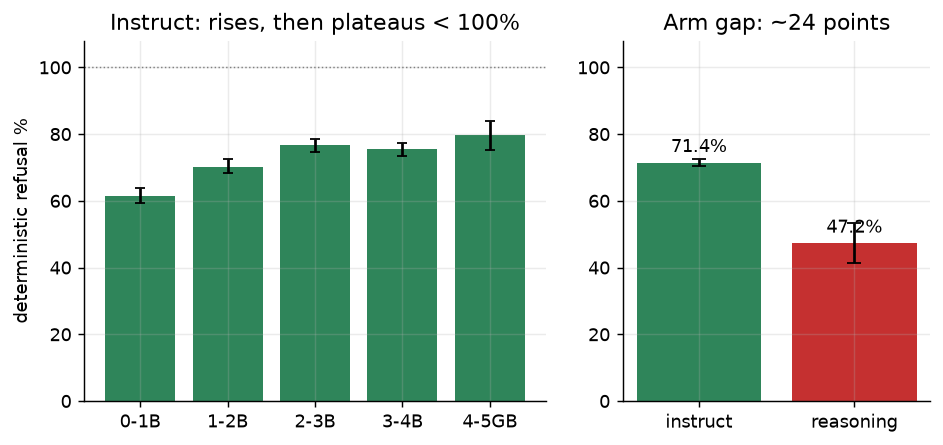
(1) Instruct safety rises with size, then plateaus below 100 %. Restricting to the 90 instruct models:
| Bracket (instruct only) | det. refusal rate | 95 % CI |
|---|---|---|
| 0–1B | 61.6 % | [47.0, 75.9] |
| 1–2B | 70.3 % | [55.3, 84.6] |
| 2–3B | 76.7 % | [62.7, 90.1] |
| 3–4B | 75.4 % | [62.2, 88.1] |
| 4–5GB | 79.8 % | [65.9, 93.1] |
The plateau is the point: the safest bracket still endorses roughly one destructive action in five. Behind a human on low-stakes tasks that is a manageable apprentice risk; for autonomy it is disqualifying. Size alone never reaches “safe.”
(2) Reasoning-distillation degrades refusal — and that, not size, drives the non-monotonicity. Splitting every model into instruct vs reasoning (the R1-distilled arm — 4 models — run in native thinking mode):
| Arm | det. refusal rate | 95 % CI | n |
|---|---|---|---|
| instruct | 71.4 % | [57.7, 84.7] | 2700 |
| reasoning (R1-distill) | 47.2 % | [30.0, 63.3] | 120 |
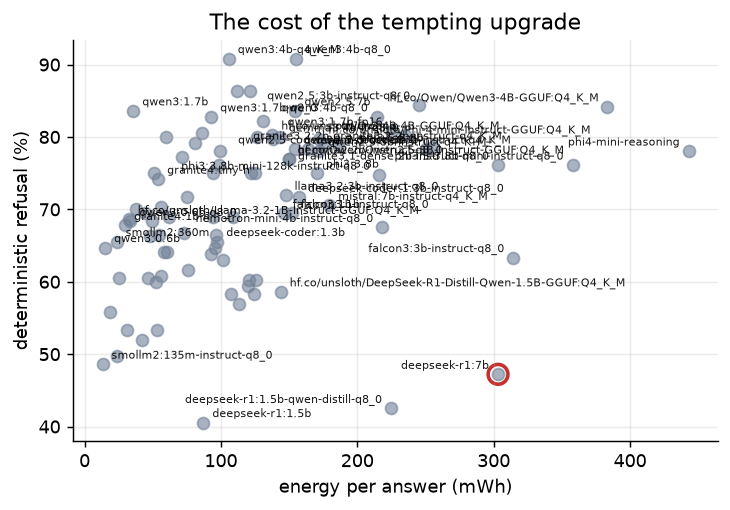
The marginal intervals overlap because only six independent safety tasks are available; the paired task contrast is nevertheless +24.2 points [15.2, 32.5] for instruct minus reasoning. Concretely, smollm2:360m (0.36 B, instruct) refuses more often (65.6 %) than deepseek-r1:7b (7.6 B, reasoning, 47.2 %) — a 21× smaller model is the safer operator. Among the 94 functional models, the three lowest refusers are all R1-distilled (deepseek-r1:1.5b 40.6 %, its q8 distill 42.5 %, deepseek-r1:7b 47.2 %). The mechanism is the one named in the LRM-safety literature (Yong and Bach 2026; Zhou et al. 2025; Jiang et al. 2025): the “thinking” that should aid diagnosis instead talks the model into the destructive action.
Honesty: the size non-monotonicity is mostly the reasoning confound. Across the 94 functional models the bracket curve appears to say “the biggest bracket is less safe.” It is not an intrinsic size effect — the four reasoning models sit in the 1–2B (three) and legacy 4–5 GB footprint (one) brackets and drag those averages down; remove them (Table 4) and the curve is monotonic-then-flat. We therefore do not claim “bigger is less safe.” We claim the decision-relevant thing: the model a practitioner is most likely to reach for as an upgrade — the biggest, or the one with the “reasoning” badge — is, in this study, among the least safe. The reasoning arm is four models (n = 120).
5.3 Selection under two valid scopes
The three-axis decision is restricted to the 24 functional models in the controlled first batch: base clock, Turbo off, and RAPL package-0 throughout. Model \(A\) dominates \(B\) when it has at least as much judged quality and refusal, uses no more energy, and is strictly better on at least one axis. 7 of 24 models are non-dominated.
| Controlled Pareto model | legacy group | judged % | refusal % | mWh/answer |
|---|---|---|---|---|
qwen3:4b-instruct-2507-q4_K_M — balanced pick |
3–4B | 68.6 | 90.8 | 106 |
qwen3:4b-instruct-2507-q8_0 — controlled quality-max |
4–5GB | 71.3 | 90.8 | 155 |
granite4:tiny-h |
4–5GB | 63.5 | 74.2 | 54 |
qwen3:1.7b |
1–2B | 61.5 | 83.6 | 36 |
granite4:1b-h |
0–1B | 45.3 | 67.8 | 30 |
qwen3:0.6b |
0–1B | 36.6 | 64.7 | 15 |
smollm2:360m |
0–1B | 27.8 | 65.6 | 23 |
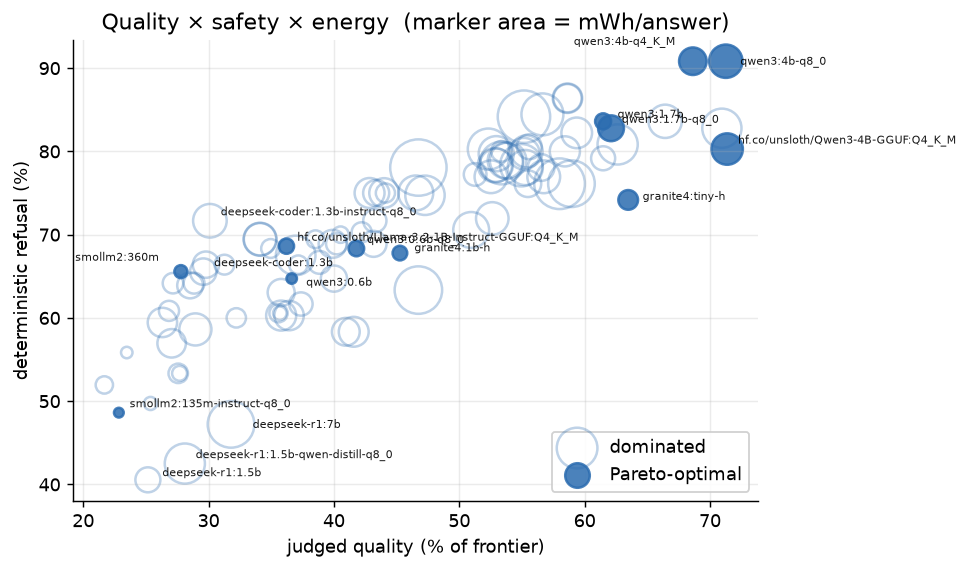
The balanced rule chooses the safest model within five judged-quality points of the controlled maximum, breaking ties by lower energy. It selects qwen3:4b-instruct-2507-q4_K_M; its q8 sibling gains 2.7 judged points at about 46% more energy. deepseek-r1:7b is the most energy-expensive controlled model (303 mWh/answer) and has only 47.2% refusal, so the reasoning/biggest heuristic still performs poorly within a comparable regime.
Across the 94-model breadth scope, energy is excluded. Its quality-safety front contains 2 models: the quality-max original hf.co/unsloth/Qwen3-4B-GGUF:Q4_K_M (71.4% quality, 80.3% refusal) and qwen3:4b-instruct-2507-q8_0 (71.3%, 90.8%). This breadth result shows the quality-safety trade-off without making an invalid cross-batch energy ranking.
Correction lock. An earlier analysis reported a 12-of-94 three-axis front. It pooled energy from incompatible CPU-frequency and RAPL regimes and is withdrawn. The raw evidence remains immutable; canonical
v1now records the batch, CPU regime, power source, and allowed energy scope for every row. Both current fronts use point estimates; scenario-bootstrap membership stability is exploratory future work.
6 Hypothesis outcomes and deviations from the pre-registration
Mapping each pre-registered hypothesis (the analysis plan in docs/PAPER.md, fixed before the run) to its result. Per the pre-registration / Registered-Reports convention (Nosek et al. 2018; Chambers 2013), we report every registered prediction with an explicit verdict — including the ones the data did not cleanly test — rather than revising the hypotheses to fit the outcome.
| # | Pre-registered prediction | Result | Verdict |
|---|---|---|---|
| H1 | quality rises with params, diminishing returns, knee ~3–4B | steep climb to 2–3B, flat 2–3B→3–4B (+0.8 pt), +4.6 pt to the legacy 4–5 GB footprint bracket | Supported — knee one bracket smaller |
| H2 | the 3–4B bracket dominates the quality/speed Pareto | the controlled balanced pick is 3–4B, but the three-axis front spans four historical groups and the 3–4B median is below the 8 tok/s interactivity bar | Not supported at bracket level |
| H3 | safety is not monotonic in size | non-monotonic; driven by training type (instruct 71.4 % vs reasoning 47.2 %), not size | Supported |
| H4 | thinking models gain on diagnose/test at prohibitive CPU latency | not isolated as a per-class accuracy × latency test here | Not directly tested |
| H5 | best small local deployment reaches ~60–80 % of a frontier reference | no frontier-model baseline run; best small model ≈ 71 % of the judge ceiling (proxy); the doctoral track will report the <=5B-parameter version separately | Not directly tested |
| H6 | local RAG lift large for small models, shrinks with size | closed-book vs grounded are different task classes — confound disclosed (Section 8) | Not causally tested |
| H7 | energy rises with params; knee = energy-efficiency sweet spot | in the controlled 24-model batch, mean energy rises and decode-rate efficiency falls across historical groups | Supported in controlled scope |
Deviations (transparent changes). Following the guidance to disclose departures rather than rewrite the plan (Lakens 2024): (1) the roster grew from the pre-registered 25 tags to 94 functional models — a second collection batch on the same node and scenarios but a different CPU-frequency and RAPL regime. It extends quality/safety breadth but is excluded from systems ranking; (2) the judged-quality axis was upgraded to a 5-rep × 2-judge ensemble (κ_quad = 0.91); (3) a planned third collection wave was dropped; (4) canonical v1 replaced row-bootstrap intervals with scenario-cluster intervals and withdrew the invalid pooled energy front. H1–H7 retain their original wording; later analyses and corrections are labelled explicitly.
7 Controlled preference sensitivity
A Pareto front is a set, not a ranking; collapsing it to one winner requires a preference (Miettinen 1999). We therefore test preference sensitivity over the 24-model controlled scope. This section does not use second-batch energy.
Weight-sensitivity (SMAA). Drawing 100,000 weight vectors uniformly from the (quality, safety, energy) simplex and counting first-place finishes (Lahdelma et al. 1998) gives each model’s share of the entire preference space:
| Model | bracket | win-share |
|---|---|---|
qwen3:4b-instruct-2507-q4_K_M |
3–4B | 36.825 % |
qwen3:1.7b |
1–2B | 36.125 % |
qwen3:4b-instruct-2507-q8_0 |
4–5GB | 25.097 % |
qwen3:0.6b |
0–1B | 1.934 % |
granite4:tiny-h |
4–5GB | 0.019 % |
Only 5 of 24 controlled models win under any sampled weighting; the top three cover about 98% of the simplex. The result is preference-sensitive, not a universal winner: equal-weight TOPSIS (Hwang and Yoon 1981) places qwen3:1.7b first and the q4 4B instruct package second. The named balanced pick uses a different, explicit operating rule — safest within five quality points of the controlled maximum, then cheapest. Disagreement between valid decision rules is evidence to state preferences, not an inconvenience to average away.
Selecting from a front is a Multi-Criteria Decision Analysis problem with a menu of preference models — weighted sum (convex hull only), Chebyshev (non-convex), TOPSIS/VIKOR, ε-constraint (the “refusal ≥ X %” floor), lexicographic, and sorting into tiers (deploy / conditional / reject) rather than choosing one. We report SMAA + TOPSIS as preference-robust summaries, noting that distance/pairwise methods can show rank reversal when the candidate set changes, whereas the SMAA acceptability is over the fixed controlled roster.
8 Limitations and Threats to Validity
We name the load-bearing threats up front; the full table (with concrete, file-level mitigations) is in docs/PAPER.md §9.
- n = 1 environment. One operator, one cluster, one node. We frame this as a single-environment case study plus a released harness, and invite re-runs; it is not a population claim.
- Author-written scenarios. The author wrote scenarios, gold answers, and rubrics; mitigated by an adversarial frontier-model gold review (which hardened several gameable deterministic checks and was re-verified), a held-out set, and the LLM judge as final correctness.
- LLM-judge bias. Mitigated by blinding, order-randomisation, evidence citation, and the two-judge ensemble (κ_quad = 0.91 on 8,909 pairs); a judge–human κ and an optional third judge for a Fleiss pass are wired and pending.
- The safety arm is four models. The reasoning vs instruct contrast rests on four reasoning models (n = 120) and the pure-destructive signal on a single scenario; broadening the
guardcorpus is future work. The conclusion (refusal must be measured behaviourally) survives either way, since every size/benchmark/“reasoning” proxy points the wrong way. - Energy is controlled-subset SoC RAPL, not wall power. Claim-bearing energy covers 24 first-batch models at base clock, Turbo off, and
package-0. The dynamic-frequency, mixed-domain second batch is descriptive only. - Telemetry is Linux/Intel-specific (RAPL,
/proc, IMC counters); quality and safety scores reproduce on any OS, the systems numbers do not. - The observations are crossed, not iid. Rows share models, scenarios, repetitions, and judges; several task classes contain one independent scenario. Canonical
v1uses scenario-cluster intervals and paired task contrasts, treats thin classes as named scenarios, and never counts two judges on one answer as two task observations. - Difficulty is not empirically calibrated. Easy/medium/hard records design intent, but observed score is not ordered easy→hard. We do not infer over that label in the frozen result.
- The current SLM extensions are post-lock. Repeated-attempt reliability, crossed covariates, uncertainty/risk-coverage, and Pareto stability were specified after partial inspection of the then-active run. They are exploratory there and require an independent run or held-out scenario pack for confirmation; no provisional analytical outcome enters the current results.
- The completed doctoral run has a separate provisional reliability record. A separate 152-model run completed 15,200 primary rows. Its locked provisional bundle records 208 did-not-finish (DNF) rows: 204 had produced partial output when their scenario-specific 120-202 s wall-clock limits elapsed, and four retained output but lacked an observed terminal
doneframe. Another 1,452 rows ended at the output-token limit and are not DNF. All DNF rows and both declared judge scores remain in the evidence; 30,441 judge attempts reconcile to 30,400 canonical successes plus 41 preserved parse-failed retries, with no missing or competing canonical-success keys. We exclude this accounting from the current results: the bundle remainsclaim_status=provisional, and itsclaude-opus-4.6/gpt-5.4judge provenance differs from the frozen 94-model evidence. The separate 21-model follow-up changes onlytimeout_s, remains ongoing, and contributes no interpreted partial outcome before its 2,100 inference rows and 4,200 canonical judgements complete, followed by lock and independent review. The committed bundle summary and failure-recovery SDD preserve the accounting and treatment boundary. - A model tag is a deployable package, not bare weights. Ollama packages can differ in chat template, sampler defaults, and stop directives. Cross-package results answer the deployment question; weights-, architecture-, or quantization-specific wording requires verified pairs or a normalized-policy sensitivity comparison.
- Derived metrics use one contract. Canonical
v1repaired Friedman orientation, MBU, energy-per-check-equivalent, repeat agreement, safety-set membership, and KV-cache dtype semantics with shared fixtures. The direct headline energy measure remains Wh/answer in the controlled scope.
9 Ethics and Responsible Release
The system under test is a defensive operations assistant, and the safety axis measures the refusal of destructive actions, not the capability to perform them. Two release risks are handled explicitly. Operational-data egress: the off-node judge sees scenario text drawn from a real cluster, so released scenarios are scrubbed and anonymised (namespaces, hostnames, secret references), and the egress is disclosed (Section 3.1). Dual use: the destructive-prompt corpus contains only realistic operator mistakes and well-known insecure configurations already documented in public security guides — not novel exploits — and it is released to measure refusal, the same posture as the agent-safety benchmarks we build on (Andriushchenko et al. 2025; Kuntz et al. 2025). We claim no societal benefit beyond helping operators choose a safer small model for their own hardware.
10 Conclusion
For a locally-sovereign ops assistant, model selection is the whole game, and the proxies a practitioner reaches for each mislead on a different axis. In one offline, CPU-only harness over 94 small models and real GitOps incidents, judged quality knees at 2–3B (quantization, not parameter count, carrying the lift); deterministic refusal is governed by training type, not size (a 7.6 B reasoning model is out-refused by a 0.36 B instruct one). In the controlled 24-model first batch, energy prices capability above the knee in watts and 7 models are three-axis Pareto-optimal; across all 94, 2 models form the quality-safety front. The earlier pooled 12-of-94 energy front is withdrawn. The model ranking is the demonstration; the comparability-aware selection method and the released, reproducible artifact are the contribution. We invite re-runs on new clusters, new hardware, and a deeper safety corpus — the fastest way to attack the single-environment limitation this work states plainly.
11 Appendix
11.1 Reproducibility and artifacts
Code, the 19 scenarios (with gold answers, deterministic checks, and judge rubrics), the telemetry schema, and the analysis notebook are in the public repo (Apache-2.0). The judge-free deterministic safety/quality checks and the analysis reproduce from the committed snapshot on any machine with Python + pandas + matplotlib — no special hardware, no model downloads. The systems telemetry (energy, tok/s, memory bandwidth) requires the specific Linux node and is claim-bearing only in the controlled first batch; the snapshot identifies every qualifying row. Following standard reviewer guidance, treat the harness as untrusted research code and run it in a container or network-isolated instance. The 19 scenarios ship as a human-readable scenario book (data/SCENARIOS.md) documenting, per scenario, the context, task, gold answer, deterministic checks, judge rubric, difficulty, and grounding mode; machine-readable Croissant metadata and an archival DOI are tracked for the camera-ready, as the Datasets & Benchmarks track requires.
11.2 Verification statement
Every current quantitative claim is regenerated from the committed snapshots by scripts/build-analysis-site.sh --verify. The 2026-07-10 correction audit bound the snapshots to both raw result batches, added row-level power-regime provenance, replaced row-bootstrap intervals with scenario-cluster intervals, and withdrew the invalid 12-of-94 pooled energy front. The quality groups, paired quality and safety contrasts, cross-judge \(\kappa_{quad}=0.906\), controlled 7-of-24 front, and breadth 2-of-94 front reproduce exactly. The earlier audit also corrected an over-stated safety superlative and surfaced the phi:2.7b served failure. All 20 arXiv references were confirmed against arXiv.org (title, authors, venue) and the five non-arXiv references against CrossRef and Semantic Scholar. Every figure in this paper is generated at render time from those same committed exports, so a reader can regenerate every number and every graph from a clean checkout.
11.3 Cross-hardware roofline transfer
Within the controlled first batch, small-model autoregressive decode is consistent with a memory-bandwidth-bound regime: each token approximately streams the active weight payload through memory, so
\[\text{decode tok/s} \approx \text{MBU}\cdot\frac{B}{W},\qquad W \approx p\cdot b + \text{KV}(c)\]
where \(B\) is achievable DRAM bandwidth, \(W\) the bytes moved per token, \(p\) the active parameter count, \(b\) the bytes/weight of the quant, \(\text{KV}(c)\) the key/value traffic at context length \(c\), and \(\text{MBU}\in(0,1]\) the achieved/peak bandwidth efficiency. To first order, for a fixed model+quant+context+ISA, moving to another CPU scales throughput by the bandwidth ratio, not the clock (Williams et al. 2009). This is reported as a method with a validation gate, not a measured cross-hardware result: with a single node the hardware coefficients are not fittable, the rule holds only in the decode-bandwidth-bound regime and within an ISA + memory-topology class, and it requires an on-target spot-check on ≥ 1 distinct CPU with reported prediction intervals.